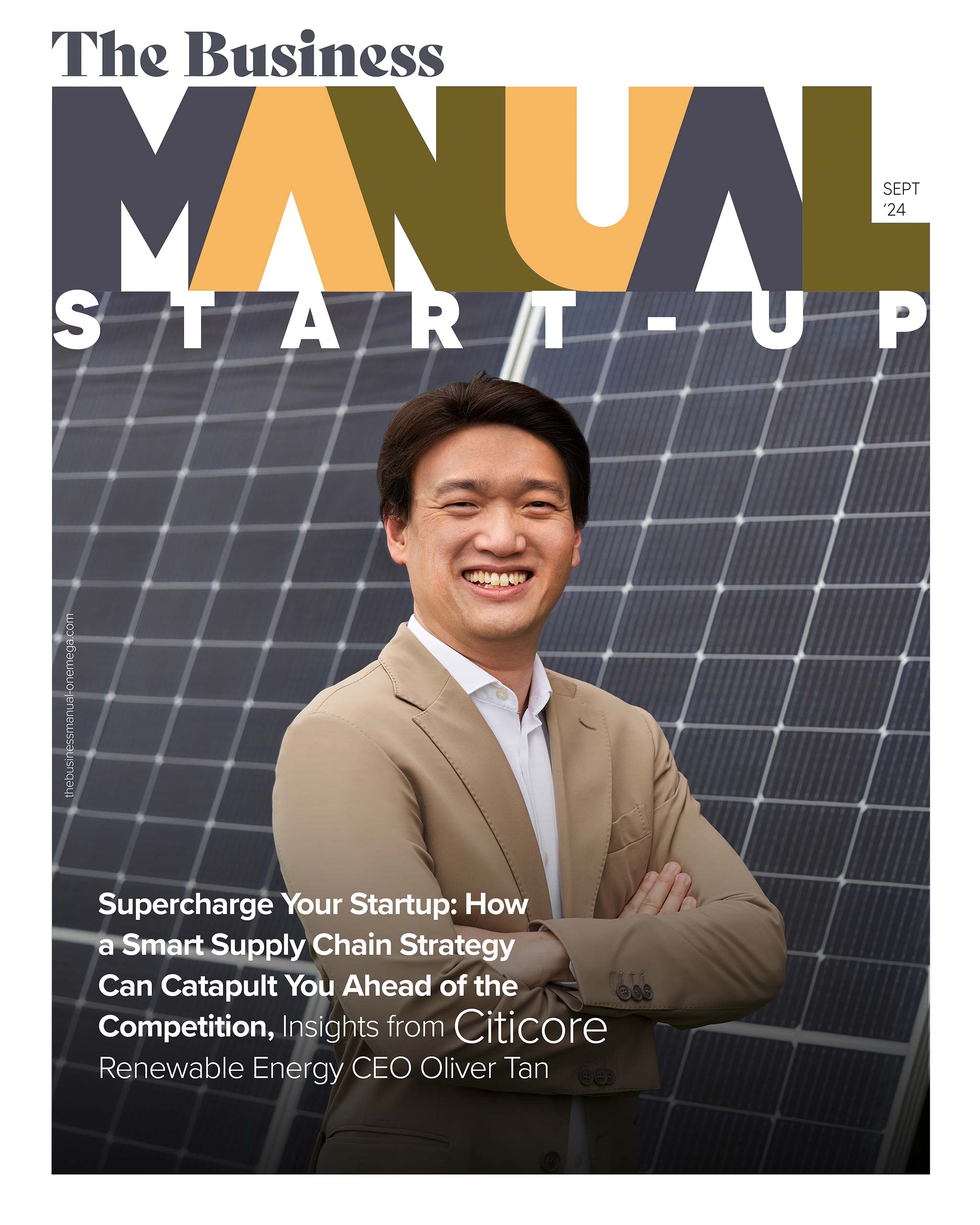
Supercharge Your Startup: How a Smart Supply Chain Strategy Can Catapult You Ahead of the Competition—Insights from Citicore Renewable Energy CEO Oliver Tan


An in-depth look at the the vision, the engineering, and the vertical integration that makes Citicore Renewable Energy Corporation’s ambitious goal of 5,000 megawatts in five years possible.
Few companies have the ambition and clarity of vision that Citicore Renewable Energy Corporation possesses in abundance. As part of the diversification and growth of Megawide Construction Corporation, Citicore entered into renewable energy where its mission is to fund, build and operate 5,000 megawatts (MW) of renewable energy in five years. And it has the means to achieve this mission, employing a first-in-the-country model of financing for the mammoth task ahead as well as vertical integration that gives the company its competitive edge.
While Citicore has much of the DNA of Megawide—with engineering at its heart—it is, itself, its own group of companies with its own mission. With Citicore Energy REIT Corp. (CREIT), it funds and buys real estate as a real estate developer. Then with Citicore Renewable Energy Corporation (CREC), it builds and operates these land-intensive solar energy plants. At the same time, it is pursuing other forms of renewable energy such as wind and hydro.
With Citicore incorporating as recently as 2015, its entrepreneurial spirit remains very much alive. Even with a successful IPO for CREIT in 2022 and for CREC in 2024, Citicore holds a position in the energy sector as the nimble disruptor, or plucky upstart, against the entrenched family-owned conglomerates.
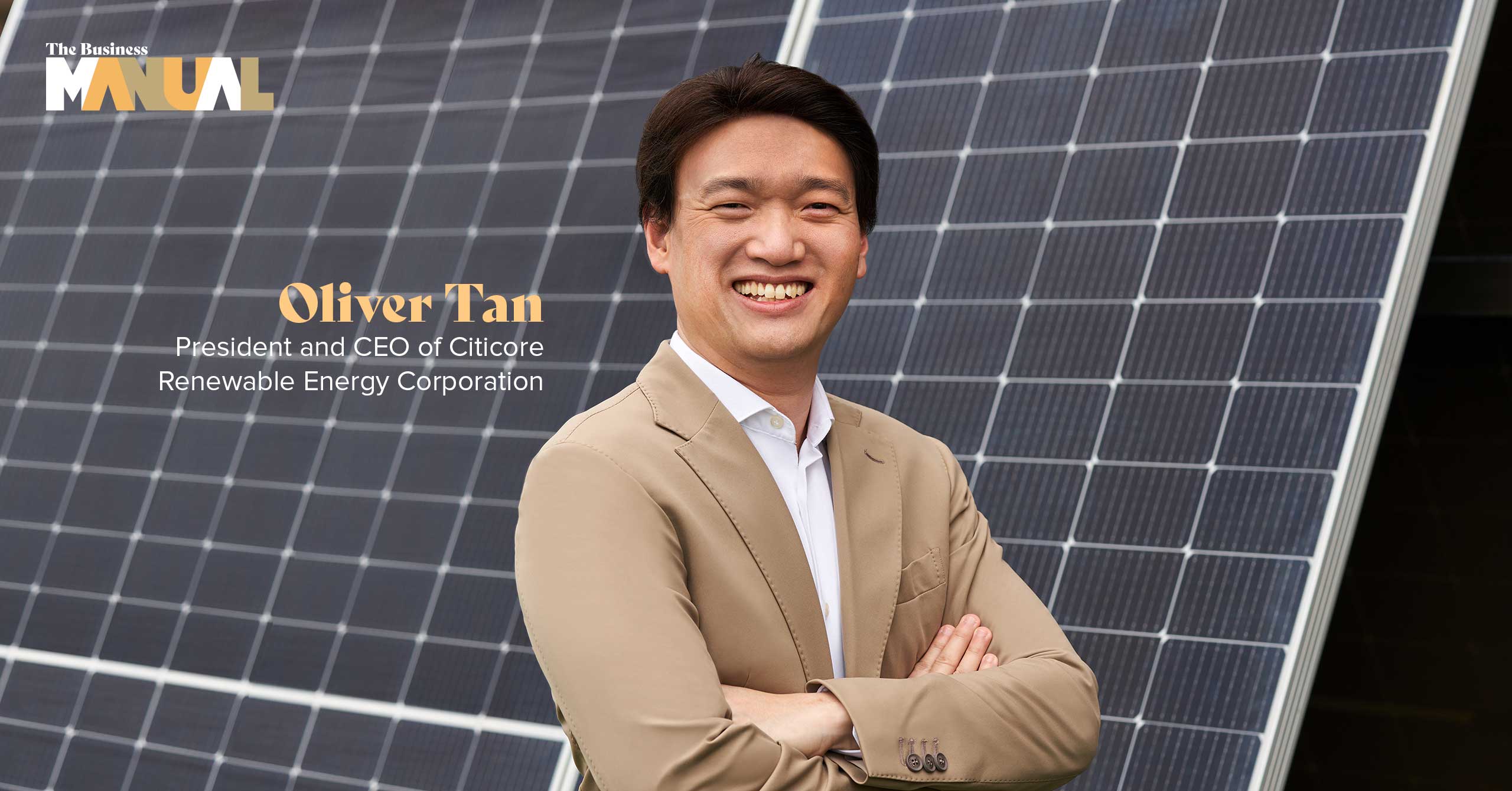
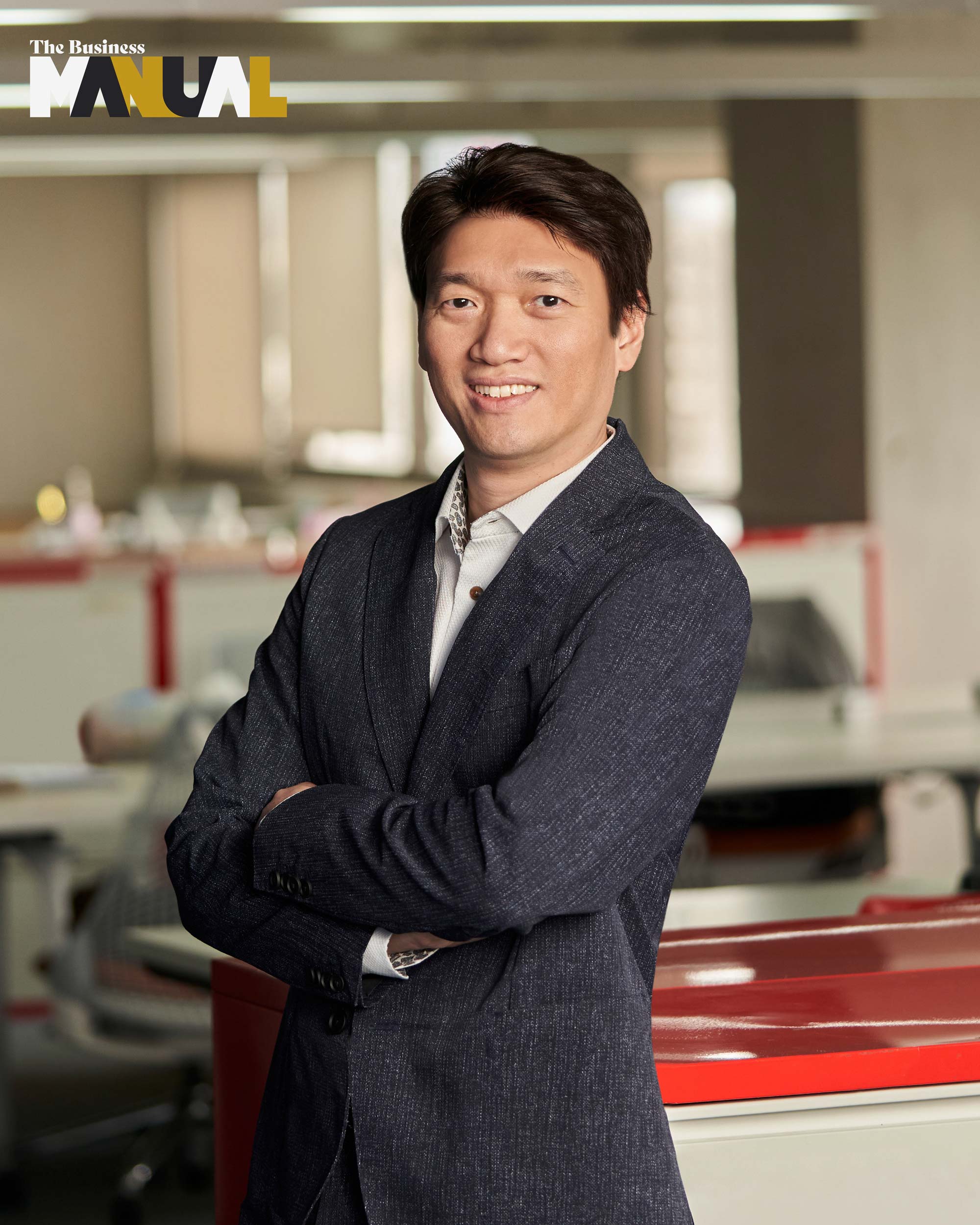
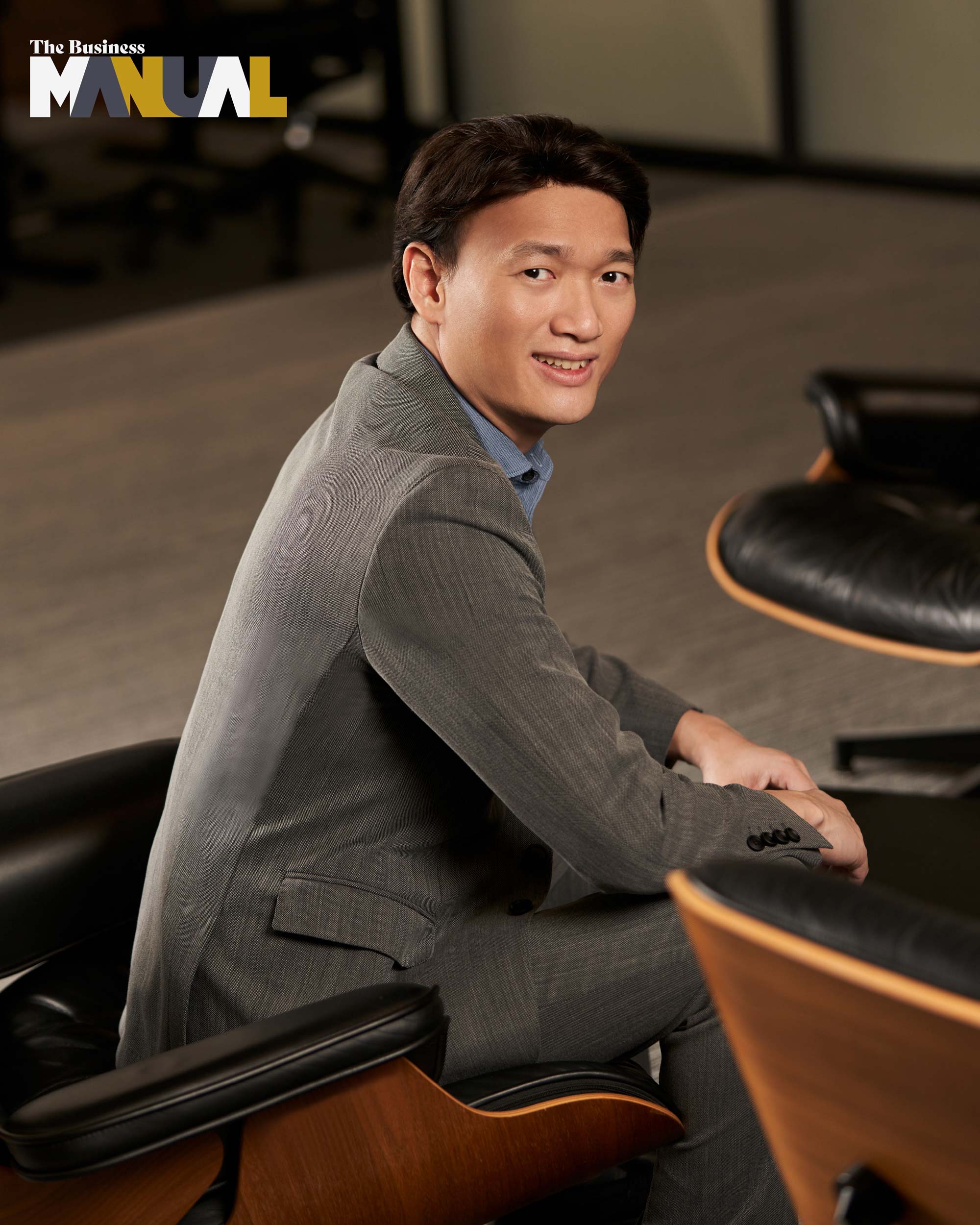
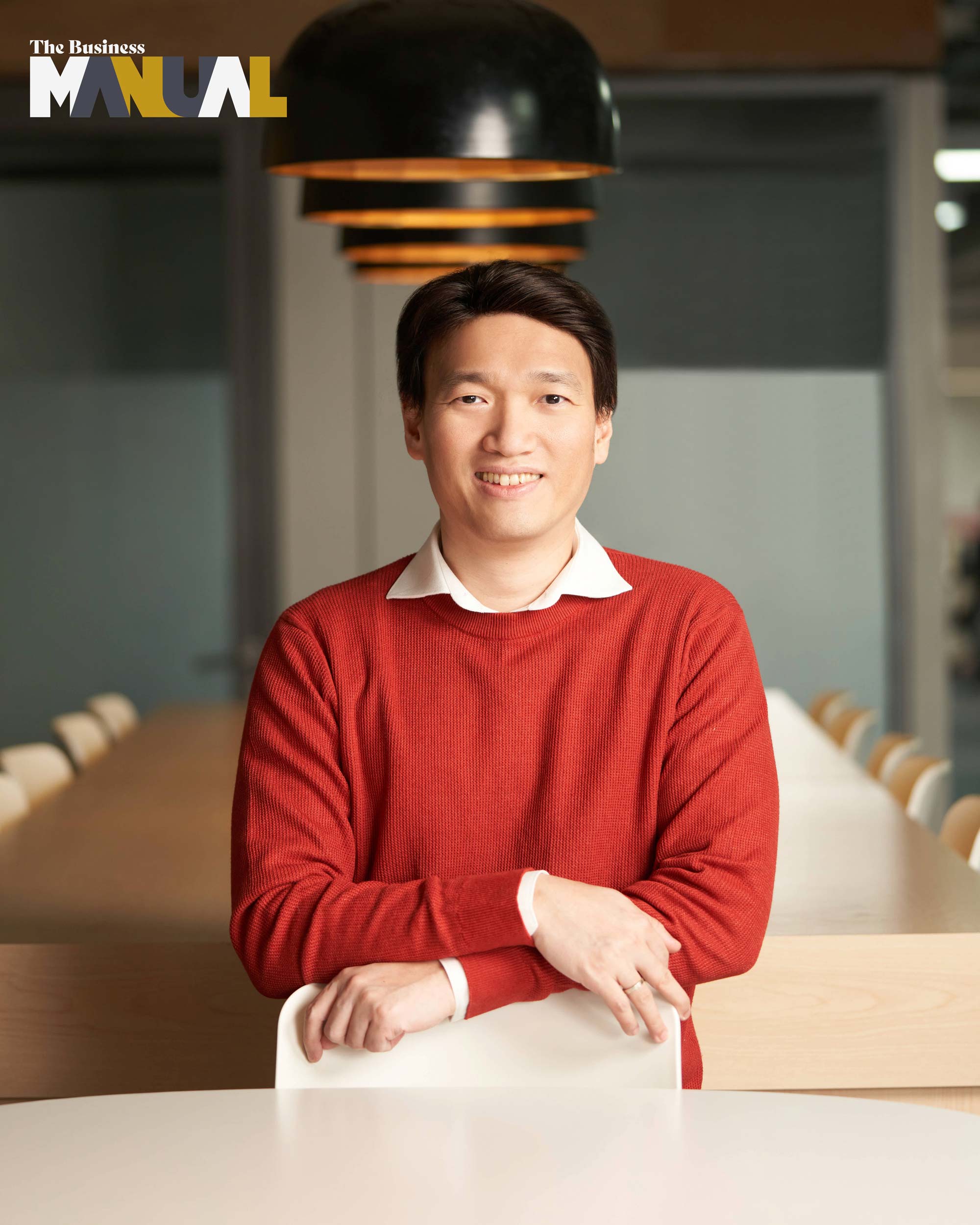
At the head of the Citicore group of companies is Oliver Tan, President and CEO of Citicore Energy REIT Corp. and Citicore Renewable Energy Corporation. He is also Director and Vice President of Citicore Holdings Investment Inc., and previously, Chief Finance Officer of Megawide Construction Corporation. The Business Manual sat down with Tan to discuss the naked ambition of his startup Citicore, how it maintains its entrepreneurial edge, and how its goals are both eminently attainable and already a tangible reality.
The Energy Landscape of the Philippines
The Philippines is hungry for energy. Driven primarily by a growing population, energy demand is expected to rise dramatically in the upcoming years. Coupled with the looming depletion of the Malampaya natural gas fields, the Philippines faces significant challenges to meeting this demand for energy. According to a report, a staggering 52 gigawatts (52,000 MW) of additional power capacity need to be created by 2045.
The government, in its Philippine Energy Plan 2023-2050, aims to answer these challenges through a mix of increased capacity in power from natural gas and renewable energy.
As of 2022, 31% of the country’s energy needs are met by coal, 32.2% by oil-based solutions, and 32.7% by renewable energy—mainly geothermal and biomass. Thus, a massive opportunity for renewable energy such as solar and wind exists. To encourage this, the Philippine government now allows 100% foreign ownership for renewable energy projects.
Citicore entered the energy field in 2015 and swiftly completed its first solar plant in Cebu that same year. To date, CREC has 10 solar power plants across the country for an aggregate capacity of 285 MW. Among these plants are:
- Citicore Solar (CS) Bulacan, Inc.
- CS Bataan, Inc.
- CS Tarlac 1, Inc.
- CS Tarlac 2, Inc.
- Clark Solar Farm, Inc.
- CS South Cotabato, Inc.
- CS Cebu, Inc.
- CS Negros Occidental, Inc.
The company has 5 gigawatts (5,000 MW) of project pipelines in varying stages of development.
From Megawide to Citicore
Oliver Tan’s leadership of Citicore, like the company itself, began with Megawide Construction Corporation. And it was there, in Edgar Saavedra’s Megawide, where he rose to the position of Chief Financial Officer.
Tan recalls having an interest in finance even before entering college. He recounts, “When my aunt thought I was going to the university, to school, I was actually spending my time in one of the local stock brokerages in Juan Luna, Binondo.”
It was here, through hands-on experience as a young trader, where Tan learned some of the most important lessons in finance.
“So that shaped my financial background that I was able to [bring] into Megawide,” he says.
After finishing a degree in Business Administration from the Philippine School of Business Administration, he established an import-export business, primarily bringing construction materials into the country. Edgar Saavedra’s Megawide was one of his customers.
In 2009, Megawide was primed to embark on its initial public offering (IPO), and Saavedra sought out Tan’s advice.
“Edgar, after hearing my [finance] background, he shared to me, ‘What do you think about my company, Megawide? This is my plan. Do you think this is IPO material?’ So I said, yeah, ‘I think it is IPO material.’ And then he laughed.”
Initially, Tan was unsure whether Saavedra was serious or not. But later on, Saavedra asked him to lead the IPO in 2011.
Speaking about the Megawide IPO, Oliver Tan says, “So it was a one-gig event. And then when we were successful, we listed Megawide.”
With the success of the Megawide IPO, Saavedra asked Tan to join the company.
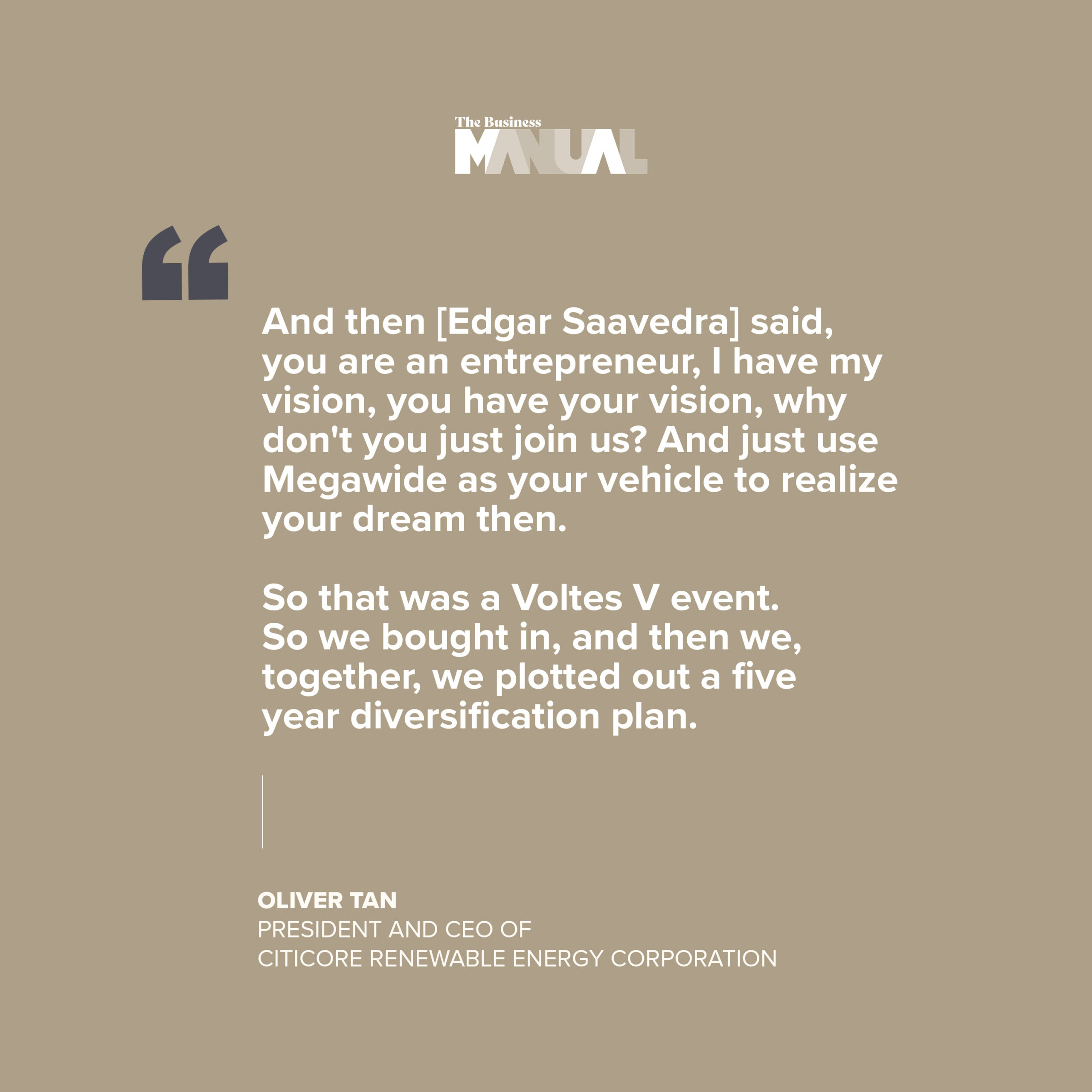
Tan recalls, “[Edgar] said, ‘You are an entrepreneur. I have my vision, you have your vision. Why don’t you just join us? And just use the Megawide as your vehicle to realize your dream.’
“So that was a Voltes V event,” Tan continues, referencing the popular 80s mecha anime. “So we bought in, and then together, we plotted out a five-year diversification plan.”
From Construction to Renewable Energy
With the Megawide IPO, the company was able to use the funds raised to expand beyond construction, into infrastructure. In addition, working with the government on projects in public-private partnerships (PPP) and transportation infrastructure would, over time, lead them towards renewable energy.
“[Construction is] cyclical, boom and bust,” Oliver Tan says on their five-year plan. “And so we thought, we need to leverage on the engineering expertise of Megawide and enter into development, asset development, whatever engineering can do. So we plotted out the transportation infrastructure and utility infrastructure.”
“So the transportation infrastructure gave birth to our Mactan-Cebu airport. And at that time, we were very active in participating in the PPP, public-private partnership of the Aquino administration,” Tan explains.
Each successful Megawide project led to others. The company built 10,000 classrooms in a PPP project with the government. Then it built the Mactan-Cebu Airport, the Parañaque Integrated Terminal Exchange (PITX), and the Clark International Airport Expansion. It is currently building the Manila Subway with its Japanese partners.
It was during 2016, when Tan spotted an opportunity. He says, “we thought that there’s really something revolutionary going on in the power space. That’s why we were one of the first movers to enter into renewable energy, solar in particular.”
Citicore was born.
Engineering in Citicore’s DNA
It was in renewable energy where Tan found he could make a difference. Leveraging Megawide’s expertise in engineering, he found Citcore’s edge.
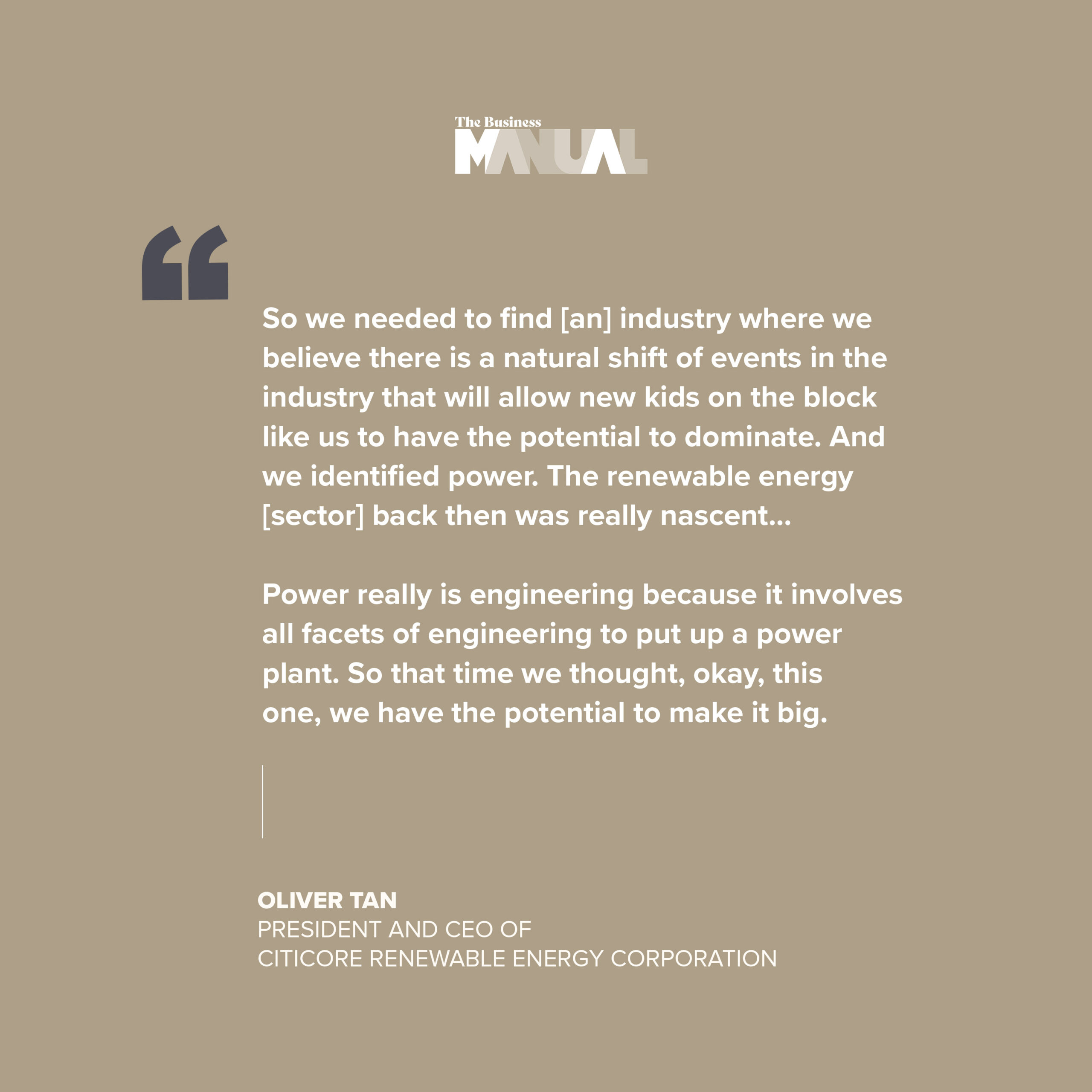
“We needed to find an industry where we believe there is a natural shift of events… that will allow new kids on the block like us to have the potential to dominate. And we identified power. Renewable energy back then was really nascent.”
Of course, entering into renewable energy meant that Citicore would compete against not just entrenched energy companies producing power through coal and other traditional sources, but also family-owned conglomerates who were also entering into renewable energy. Unfazed, Tan fancied his chances, saying, “So we thought, okay, this probably is an industry where we can excel because… if you look at the players, none of them… is really a pure engineering [company].”
Tan says, “Power really is engineering because it involves all facets of engineering to put up a power plant. So that time we thought, okay, this one, we have the potential to make it big.”
Green Principle
Another edge that Citicore has is what Tan calls its “green principle.” While it may seem like belaboring the point to mention that a renewable energy company is green, for Citicore, green engineering compounds its environmental benefits. It also makes sense for the bottom line.
“Well, I think we look at things differently,” he says. “Everyone thought going green that time is expensive, but we studied the model. On the contrary, by going green, in our case, green construction, it actually gives us a better return because by going green, you ensure that you recycle whatever you can recycle from steel, formworks, everything.
“So we just look at it differently now. Yes, initial capex may be expensive, but in the long run, it is feasible.”
Ever the CFO, Tan returns to the financials.
“True enough, our margins are, if you look at our financials,” he says, “a chunk of that was really because of the DNA of going green.”
Through Citicore’s engineering expertise, it has found innovative, new solutions in the renewable energy space.
One logical engineering solution is to raise the efficiency of solar panels. Citicore employed its own design to increase efficiency in the solar panels it uses. Another solution is agro-solar.
“We pioneered the agro-solar concept [in the country],” Tan says of their breakthrough work which allows the same land to be used for both solar power generation and agriculture. “Because solar, obviously you occupy a huge tract of land, right? And we know ever since that we should not sacrifice food security for energy security.
“That’s why we pioneered agro-solar wherein we design our panels to be able to allow farmers to continue to plant high value root crops beneath our solar panels. That’s one of the innovative solutions that we brought in.”
The Country’s First Energy REIT
An integral part of Citicore’s formula—and one which supports their ability to build fast and at scale—is Citicore Energy REIT Corporation.
“[CREIT is] actually the first renewable energy-themed REIT to be listed in the Philippine Stock Exchange,” Oliver Tan says with pride. “First we thought, why don’t we do a straight IPO of the parent? But that time, we saw that there was a special interest among local investors for REIT products.”
A REIT, or real estate investment trust, is a stock corporation created for the purpose of owning income-generating real estate assets. Traditionally, these involve land assets for commercial or residential development. However, the assets of a REIT may also be used for other purposes, such as infrastructure. Or renewable energy.
During CREIT’s IPO, Tan says, “It’s all pure vanilla office building REIT, property REIT. That was the time when we said, okay, if we can offer something different to the market with the same stable recurring yield that these investors are looking at, but a different flavor, not your pure typical office building. That’s when we came up with this structure.”
Tan continues, “We’re the land [owners] where our solar plants are situated. So [we] become the landlord. It leases the land to different solar operators. Hence, it becomes a REIT.”
Despite this innovative solution, it wasn’t all blue skies for CREIT. It took regulators over a year to approve the product.
“[Regulators] said that when the legislation was crafted on the REIT, the spirit behind [it] was really property. But we said, times are changing. Look at Singapore, look at Japan, they have infrastructure REITs, they have all kinds of REITs. So [after] more than one year of convincing, they finally agreed.”
Even with a greenlight from regulators, Citicore had difficulties finding an investment bank for its IPO.
“No banks, no investment banks believed that this is going to work,” Tan says. “That’s why we settled with a smaller boutique investment bank because you cannot do an IPO without an investment bank and a writer. But lo and behold, the market accepted the product and the rest was history.”
When all was said and done, the CREIT IPO was awarded Best IPO (Philippines) by The Asset Triple A.
Vertical Integration
“If you look at the space right now, the industry,” Oliver Tan says, “we are probably the only vertically integrated [company].”
It is this vertical integration that he credits for giving Citicore another competitive edge.
“So we do greenfield development in-house from land acquisition, securing permits. And we do the engineering procurement construction in-house because that’s where we started the business.
“And post-completion, we operate and maintain our plant in-house. Most of the developers out there, they obviously have to outsource to a third party to do the construction, and outsource to a third party to run the plant. This vertically integrated model gives us two significant advantages:
“One, speed to execution.”
Tan cites that Citicore is currently building eight to 10 projects at the same time. “Imagine,” he says, “tendering out eight times, ten times, versus one go.”
“The second advantage, obviously, is competitive pricing and cost because it’s vertically integrated. Everything is done under one umbrella.”
Building for the Future
Today, Citicore is making a vision of a Philippines powered by clean, renewable energy a reality. With 10 solar plants producing a total capacity of 285 MW and eight to 10 more projects under construction, Citicore is well on its way to achieving its goal of 5,000 MW in five years.
“That’s your first gigawatt.” Oliver Tan says, “because the plan is to do one gigawatt every year until 2028. So the first gigawatt is already under construction. We target completion by next year, early next year.”
As for Citicore’s second gigawatt for 2025, work is already underway. This time, capacity will include onshore wind projects.
“By next year,” Tan says, “we will have four onshore wind [farms] that will break ground. We’re looking at it from a portfolio basis because our vision, which we have yet to realize, is that we will be able to supply baseload of pure renewable energy.”
Given the limitations of solar energy, it is engineering once again that comes to the rescue. Tan envisions a mix of wind and battery storage as a solution. He says, “So with wind and with the battery energy storage system together with solar, it is our vision, and we believe that we will be able to supply 24 hours, 24×7 of pure renewable energy.”
Entrepreneurial Spirit
Citicore has come a long way in just under a decade. Beginning as a startup to diversify Megawide’s business, it has grown into a leader in renewable energy. With CREIT’s and CREC’s IPO, the group is now firmly in the corporate space, with responsibilities to shareholders and all that entails. However, Oliver Tan insists on maintaining the entrepreneurial spirit that Citicore began with.
Tan highlights the difference between entrepreneurs and corporations, saying, “All of us, Edgar [Saavedra], me, Louie [Ferrer], we are entrepreneurial. None of us came from a corporate background, corporate setting. Of course, when you are publicly listed already, you are now forced to behave like a [corporation].
“An entrepreneurial setting would be, you know, after you analyze that business concept, boom, you just go and take the risk, right? This one, you really have to go through all the channels. So it took quite a while for us to learn how to behave like a [corporation] without losing our entrepreneurial spirit because sometimes you may lose it.”
With Citicore’s entrepreneurial mindset, it has been able to grow rapidly and adopt innovative solutions in the engineering and the financing of its projects. Staying entrepreneurial is an edge that Oliver Tan wants to hold on to.
He says, “We are very careful now, because the disadvantage of being corporate… the decision is not as fast as an entrepreneur. So there’s a good and bad being a corporation. That’s why we’re very careful. Okay, we will adopt that corporate setting, but retain our entrepreneurial spirit.”
‘Huge Potential for Future Entrepreneurs’
In parting, our editor-in-chief, RJ Ledesma, asks Oliver Tan for advice he would give to entrepreneurs with “big dreams and small pockets.” How can they aspire to reach the scale of Citicore?
Oliver Tan replies, “If you’re an entrepreneur, you should love the Philippines… If we are living in a first world country, I would agree with you, it’s very difficult to be an entrepreneur in a first world country.
“But because we live in a developing country, there’s huge potential for future entrepreneurs. You just need to have a big vision. Big vision and have that passion because it’s never going to be easy. That passion will give you the tenacity and the determination to really continue. Keep moving forward to reach your goal.”
Text VINCENT SALES
Photography JHARWIN CASTANEDA assisted by ALJON CELIS
Videography OMAR VILLANUEVA assisted by RJ CRUZ
Art Direction ANDREA SANGCO
Sittings Editor RJ LEDESMA
Shoot Coordination TONI MENDOZA
Shot on Location CITICORE RENEWABLE ENERGY CORPORATION, ROCKWELL SANTOLAN TOWN PLAZA