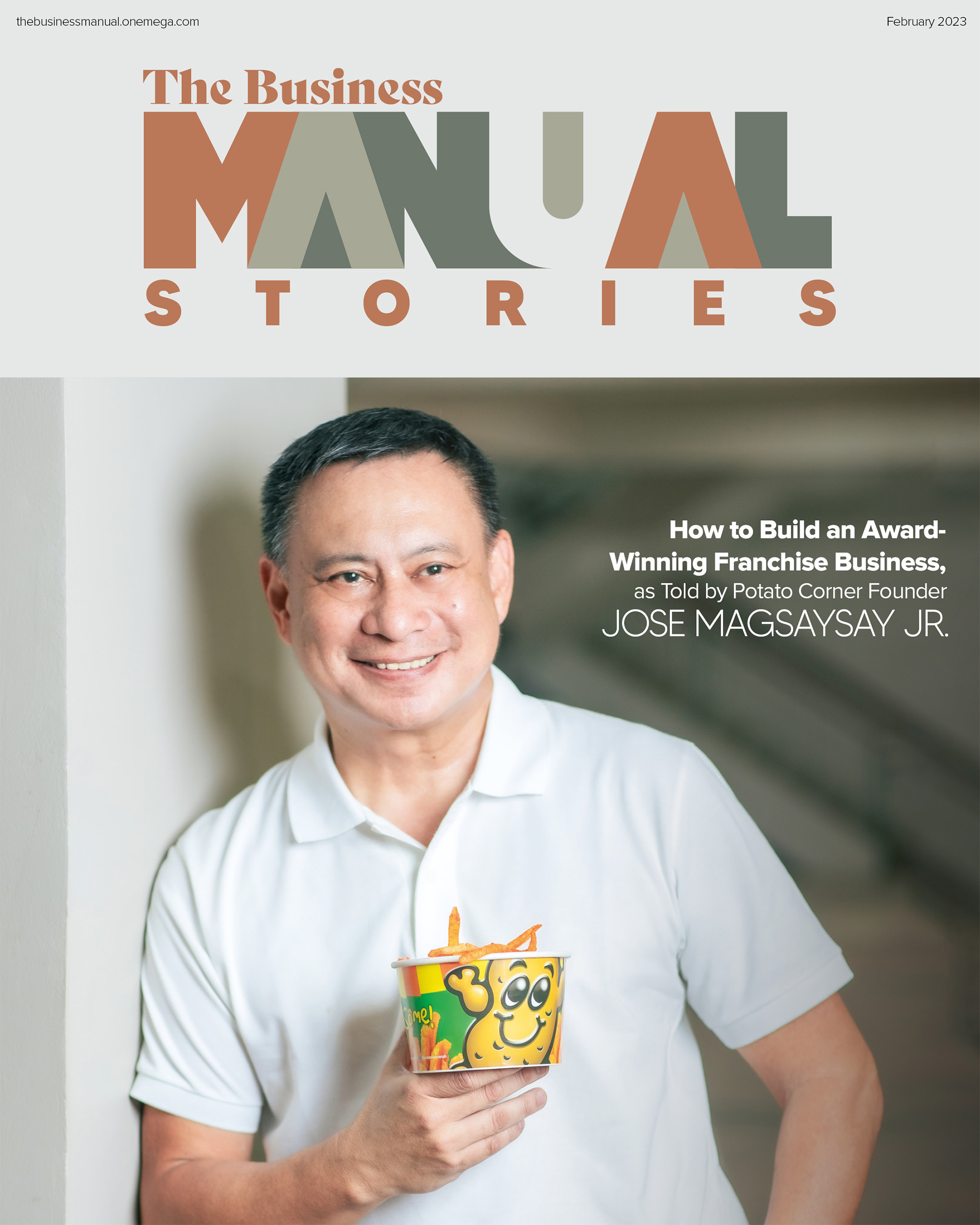
How to Build an Award-Winning Franchise Business, as Told by Potato Corner Founder Jose Magsaysay Jr.


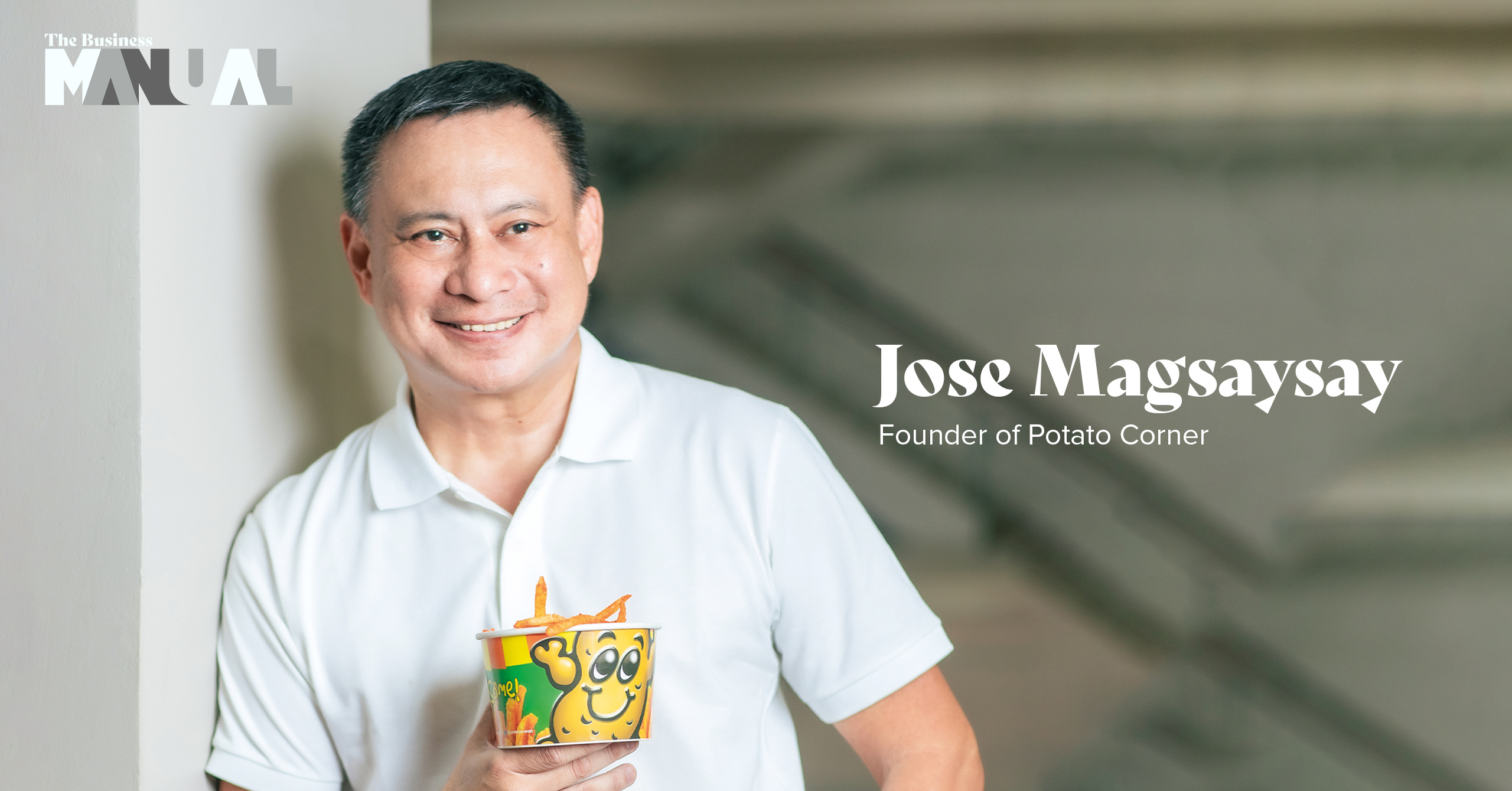
From a simple kiosk to a global brand with branches in almost every corner of the country, Potato Corner is a model example of franchising done right. Founder Jose Magsaysay Jr. reveals how.
There is power in numbers and Potato Corner is proof of that. In fact, the brand boasts of over 1,400 branches around the world—more than 1,200 in the Philippines and more than 200 outside the country, specifically in Indonesia, USA, Canada, Panama, and most of the ASEAN area before being sold to the popular pizza brand Shakey’s.
With that, the popular flavored french fries brand has undeniably established itself as a top-of-mind choice in the hearts (and palates) of every Filipino.
The brains behind all this? Co-Founder and CEO Jose Magsaysay Jr.—known to many as Jomag. But before building Potato Corner into the award-winning franchise empire of today, his entrepreneurial journey started from humble beginnings: working part-time at fast food chain Wendy’s.
Even more surprising? He was cleaning restrooms and kitchens there!
While not the most glamorous job, it’s just as important and everyone has to start somewhere, him included. But this soon paved the way for more opportunities—not just in his workplace, but also in business ventures that all led up to the billion-peso food franchise, Potato Corner.
In this exclusive interview with The Business Manual, Jomag shares how it all began.
Where it All Began
An entrepreneur’s journey varies from person to person, with experiences coloring it into a myriad of possibilities. For Jomag, it took an unprecedented turn in the form of, what he calls, “one accident after another.”
“Nothing was planned and it just kept on going and going—[one] step at a time,” Jomag begins. “When I was in college, I needed some funds for my allowance. So I worked part-time at Wendy’s, then that started my [interest in] food.”
As a Communications Arts student at De La Salle University, he took on another part-time job, but even so, it was easy to see where his heart was set. “I [also] worked part-time for my cousin, Jun Magsaysay, in his cable TV business, but I spent more time at Wendy’s. I focused on Wendy’s. Learned how to cook fries. Eventually, they offered me to become a full-time employee there.”
“While at Wendy’s, I was starting a family, and then I started thinking [about] how can I make extra money or income. So I started selling watches [and] small appliances to my fellow employees,” he says.
This, however, came with a painful lesson. “When you sell in installments, which I did, it’s hard to collect. Every payday, I’d be there, watching them, reminding them that they owed me money—their monthly payment to me. So difficult, but at least it started my entrepreneurship journey.”
“And then, also at Wendy’s, I started collecting boxes because I needed more income,” he shares. “Once I could fill a car full of those empty french fry boxes, I brought all the boxes to a junk shop in Bulacan and sold them. So my profit margin was 50 centavos per box. Decent income for extra [work].”
The Start of Something New
As someone who is no stranger to having side hustles, Jomag received an invite from his brother-in-law, Ricky Montelibano. Little did he know that this would soon pave the way for the beginnings of something new—something big. “Ricky Montelibano said [to me], ‘Jomag, me, Danny, and Jorge are starting a flavored french fry business. Would you like to join? We’d like you to join and help us run the business.’ I always needed something extra for a start-up family so I said yes while I was still at Wendy’s.”
“[They] computed and told everybody [that] we need PHP 150,000 to start this flavored french fry business,” Jomag adds. “When I entered, they had a name: Potato Corner. [Around] four to five months [back then], when I joined the partnership of Ricky, Jorge, and Danny, we opened our first store already in SM Megamall. [But] I was still at Wendy’s.”
The idea took flight and despite the humble beginnings of Potato Corner, it was well-received by the public. “I didn’t know it was going to be a hit so [during] the first month, we paid back [our loan],” he laughs.
But with it came a choice. “[Potato Corner] started creating a lot of stir, especially at Wendy’s, where I was still an employee,” Jomag says plainly. “And then I got a call from the office of the president of Wendy’s—Titoy Pardo. I went to his office and wondered what [it was about]. This was the first time I got called to the office of the president of Wendy’s Philippines.”
“So he said, “Jomag—’Alam mo‘, he made it [sound] so nice–’Mamili ka. You choose, Wendy’s or Potato Corner?'” he recalls. “I chose Potato Corner because I made a commitment to my three partners at Potato Corner that I will help run the business and scale it.”
“And he said okay. Titoy Pardo shook my hand. He understood. In fact, he said in his own autobiography, ‘You know, I really felt that Jomag was an entrepreneur and I wanted him [to] go and put up his own business. That’s the reason why I called him to my office,'” Jomag points out.
With the path clear to focus his efforts on building up the business, Jomag did not have any regrets when he left Wendy’s. But it came with some memories. “I’m happy I did that and it forced me now to focus on Potato Corner 100%. I was sad, of course—I lost my 10 years at Wendy’s. Wendy’s was very special to me,” he recalls fondly.
Nevertheless, like all experiences, it shaped Jomag’s work ethic. “At Wendy’s… and this is the way I work—100% in everything. No social life. No vacations. All Wendy’s. I worked even Sundays. No days off.”
“In fact, that kind of working habit, of 100% all-in is what I brought to Potato Corner also. And that’s why maybe Potato Corner is where it is today because of my commitment to the brand, to the company, and to my partners,” he adds.

Potato Corner: A Pioneer Ahead of its Time
In order to stand out in a competitive playing field, all businesses needed an edge—an advantage that set them apart from everyone else. For Potato Corner, it took different forms.
Selling Flavored Fries With a Ritual Unique to the Brand
Going back to the basics, the very business model of selling flavored fries was an innovation in itself—as a competitive advantage and something it pioneered ahead of its time—given that not many businesses back then sold the same thing.
“The flavored french fries—of course, that was, you could say, number one,” he says simply. “The second I always say is the novelty because it was the first time people saw people [cooking fries in front of them]. We shook the fries. [It was] the ritual, the showmanship. So it’s very important that there is always a ritual that you own.”
“Shakey’s has a ritual, the way they cut their pizza. Dairy Queen has their ritual—the way they turn the ice cream upside down. So for Potato Corner, it’s [the] shaking,” he explains.
Creating its Own Line of Seasonings and Flavors
Given the straightforward nature of Potato Corner, its business model can easily be replicated by competitors who see potential in that line of business. Despite this, Jomag was unfazed. “[Compared to] the other flavored french fry businesses, I think we stood out because we didn’t buy seasonings or flavors from Divisoria or Quiapo.”
“We had our own seasonings developed—custom-made for Potato Corner. Even our international stores are still custom-made up to now,” he says proudly. “Of course, they’ll say, ‘french fries are french fries.’ I can copy Potato Corner anytime just by buying flavoring anywhere in the store. But the difference is really [in] the way we cook it.”
In fact, Potato Corner has established its very own lab—a large-scale establishment in Glorietta Mall, which offered unique and premium flavors that cannot be found in their kiosks. An incubator of sorts that tested which flavors did well and which did not, it gave Jomag insight into what the market wanted.
“That’s who we are. We keep on experimenting,” Jomag says when asked about the reasoning behind the lab. “I’m very lucky that my shareholders—my partners in Potato Corner—gave management a very high latitude to experiment, make mistakes, and not be called out right away because we made a mistake.”

Selling Flavored Fries in a Kiosk
Another innovation includes selling said flavored fries in a kiosk. This not only saved the company on overhead expenses—part and parcel of owning a store—but its size and nature make it an easy addition to every shopping mall or establishment.
“Normally, people use what McDonald’s and Jollibee use: big, standalone deep-fat fryers. So we placed a fryer—the way to serve flavored french fries—in a kiosk. In a two square-meter space. That’s the innovation,” Jomag says.
In fact, this model made it easier for just about anyone to get into the business! “You can now be an entrepreneur [with minimum capital requirements.] When we started in 1992, it cost PHP 70,000 to be a Potato Corner franchisee. You partner with us [for just] PHP 70,000.”
Multiplying its Outlets
“The innovation of Potato Corner was really to multiply the number of outlets,” Jomag shares. “Because in the first two years of Potato Corner, we tried to count how many people copied the flavored french fries business, and we counted at least 300 different brands.”
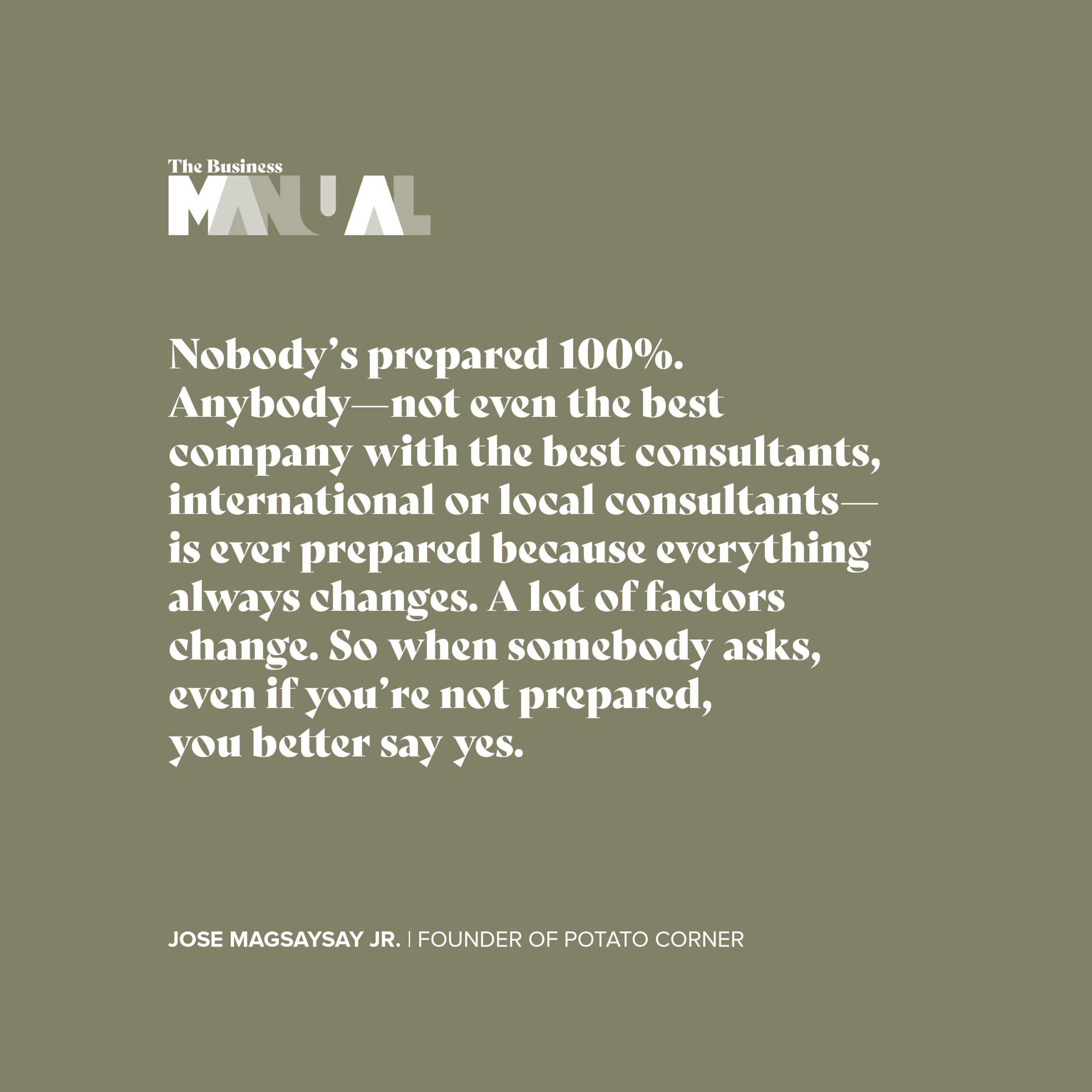
This, however, is a big commitment, and with it, comes many risks. When asked about the right time to franchise or grow a business, the franchise expert answers simply, “If somebody asks you, you better say yes because nobody will ask you again. There’s this window of opportunity that will leave you if you say no.”
What about the first one who asked to franchise Potato Corner? “We just shook hands,” he says, plain and simple. “There was no [written] agreement. There was nothing. In fact, it was not a franchise. It was a partnership—a joint venture. We just called it a franchise.”
“That really helped. That’s the innovation there. And if you look at Potato Corner, [for] the last, almost 30 years, our franchise fees were relatively the same—flat. We never increased it because we wanted our partners, our franchise partners, [and] franchisee partners, to recover their investment quickly.”
The result? Franchisees opened multiple stores. “Some with 60, some with 70 stores. Because the business model is [that] we make sure that you can bring back your investment as soon as possible,” Jomag declares.
The Road to Growth and Expansion
Expansion can take many forms—angel investors can come in to help the business grow through funds, or partnerships may pave the way for joint ventures. For Potato Corner, its growth came from franchising, but even so, there was a skill in doing it right.
“There are many ways to skin the cat so that you can expand right away,” Jomag explains. “Of course, there are things you have to be rigid about, but there are things that you should be flexible [about]. Because we were able to expand right away, through our franchise innovation, the kind of franchise we did, we were able to grow 220 stores, whereas the competition—those 300—[only had] either a single or a maximum of two stores only.”
A risky move, given that Potato Corner was a small fish in a big pond, Jomag knew that he had to play his cards well. “I had to borrow my 37,500 shares in the business [for this]. So imagine if another group with a huge war chest comes in. They could open right away maybe 10 to 20 [stores] and kill us right away!”
But this was necessary for the business. “For me, if you want to be perceived as the first mover or the dominant brand, you have to be the one growing and growing quickly. Otherwise, somebody who has more capital can just overtake you and be perceived as the first mover.”
Beyond growing the business and establishing a stronger brand presence through its many branches, the fundamentals behind franchising Potato Corner stemmed from Jomag’s personal goal: giving or sharing.
![My personal core really is really giving or sharing. Sharing your profits [with] a franchise. But we did [that back then] also because we lacked [the] capital to grow, to put up our own stores. We said [that franchising is the best, or maybe licensing, because you're using other people's money, other people's time, and organization. - Jose Magsaysay Jr](https://s3.ap-southeast-2.amazonaws.com/assets.thebusinessmanual-onemega.com/wp-content/uploads/2023/02/JOSE-MAGSAYSAY-QUOTE-2-scaled.jpg)
On Challenges Faced and Knowing What to Prioritize
The road to building a business is paved with lessons and at times, failures. While most prefer to hide the shame of their past, Jomag candidly uses his to learn, improve, and power on. “[In] all these almost 30 years, we made so many mistakes, but we got to where we are because of all those mistakes,” he reveals. “So we have a vast experience in what not to do because what you’re going through now, we already [went through it].”
In Potato Corner’s case, the tumultuous waves took place in the lowest lows of every business: the Asian Financial Crisis and the COVID-19 pandemic. “We started in 1992, right? Then 1997 was the peak in the 90s. But 1998 [was] the start of the Asian Financial Crisis. That affected our cost of goods,” he recalls.
“Right after the financial crisis, in 2000, we ended up almost closing every store. But thanks to our franchisees, about 40 stores were all-franchise operated, and they kept it open because they love the product and the brand. All corporate stores were closed.”
“That’s how special we see our franchisees because, during good times, we take care of them. During bad times—during the Asian Financial Crisis [and] during this pandemic, you know who took care of the company? Our franchisees. They took the bullet for us,” the entrepreneur says.
With that being said, Jomag returns the favor by taking care of his franchisees, too. “But during good times, we always take the bullet for them. Those spikes in high costs, those spikes in some financial [areas], we take the burden for them. We make sure we stabilize costs for them,” he adds.
This reciprocity is something he believes is the very heart of franchising. “I think a lot of franchisors should learn to show how much they care for their franchisees,” Jomag opines. “And I’m going back to the sharing again—sharing our profits.”
And yes, this was necessary, even when the company was doing well. “We were at a certain stage already during our regrowth again after the Asian Financial Crisis, [where] we could already afford to make everything company-owned. But we didn’t. We still kept 80/20: 80% franchise, 20% company.”
“Going back again to sharing. We share our entrepreneurs. During the last 25 years, we encourage our employees to be entrepreneurs also,” he adds.
![We said to ourselves, this is the strength of the brand: our franchisees. That's why we still keep that 80/20 ratio and we take care of them in spite of our being able to afford [it]. And that's our marketing. The reason why we are growing this way is because [of] our franchisees and our brand ambassadors also.
Our consultants because we work so much with so many consultants out there. - Jose Magsaysay Jr](https://s3.ap-southeast-2.amazonaws.com/assets.thebusinessmanual-onemega.com/wp-content/uploads/2023/02/JOSE-MAGSAYSAY-QUOTE-3-scaled.jpg)
The Importance of Taking Care of His People
If employees are the lifeblood of a company’s day-to-day operations, franchisees are what keep a business going and growing. During the height of the COVID-19 pandemic, both were affected, but Jomag had a game plan to save both.
“I’ll go back again to sharing,” he says. “You know what we did? All the stores were closed and we didn’t want our employees to lose their jobs. We had to lay off a lot of people also, but [for] those people who had to go for a while, we told them, ‘You take care of Potato Corner. You become entrepreneurs while you’re out of the job.'”
Surprisingly enough, Jomag didn’t limit their franchise choices to just Potato Corner. “During the pandemic, we even encouraged them to franchise our other brands or other brands they like, and we even sometimes finance it. It comes from my own pocket also,” he reveals.
“That’s what helped us. Our franchisees’ houses became shophouses. They started selling flavored french fries in their communities,” Jomag adds. “Our employees who are out of the job, [their houses] also became shophouses. We tried to make everybody we knew entrepreneurs, and that helped Potato Corner during the pandemic.”
Passing the Spud: A New Chapter for Potato Corner
With Potato Corner’s resounding success, many investors set their sights on the brand. But one big fish won: Shakey’s Pizza Asia Ventures Inc. Thus, in December of 2021, the official announcement was made that the family-owned company was acquiring Potato Corner—from its assets to its intellectual property, as well as ownership of all stores. This meant serving as the brand owner and franchisor of stores being operated by franchisees, both domestically and internationally.
When asked about what drove him to choose this route, Jomag’s answer was clear: “It’s a collaboration with all the shareholders and the offer was good. The offer was very good.”
“If you ask me personally, I’m a senior citizen already and I’ve had five brain surgeries already,” he reveals. “And I have hydrocephalus and that’s a lifetime thing for me—my brain. So my horizon is always short ‘cause I don’t know if I will go tomorrow, today, or maybe a month from now. So that’s a question mark for me.”
This, in turn, has changed his perspective on doing business. “My horizon for business now is very short. If I invest in something new, it has to pay back,” he explains. “That has impacted how I decide on business now.”
Truth be told, Jomag even reveals that they didn’t even have to sell Potato Corner, given that the business was thriving. “We didn’t have to market that we were selling Potato Corner. We got offers,” he says. “We started getting offers in 2018, then every year pila-pila yung offer. We were just lucky that all the young people—all the older people who used to be young who loved flavored french fries really helped us.”
“To us, our customers really should be shareholders also. We should call them shareholders. We should award one share to everybody who loves Potato Corner,” he jokes. “Because of them, we were able to exit well. We’re happy.”
Parting ways with a brand that he has cultivated from its humble beginnings to the empire that it has become is truly a sentimental feeling for the entrepreneur. Despite this, he has nothing but fond words for this goodbye. “We’re now sharing our business [with] another party who sees a lot of potential in the brand. Again, it’s [still] sharing. I’m not here to accumulate wealth. I’m here to share what I have, what I own, [and] what I know.”
Emerging Opportunities and Possibilities
Jomag’s time with Potato Corner may have come to an end, but the entrepreneur still shows no signs of stopping. Based on his success in building and growing the brand into an award-winning franchise business, he has been receiving many offers—from becoming a partner to being a consultant, or even an adviser.
In fact, he even guested in the reality business TV show, The Final Pitch! “Because of John Aguilar, I had fun,” he recalls. “I was an investor in Final Pitch and that opened a lot of doors for me, [even] until now. I was in season one of Final Pitch and until now I still reap the dividends of being in Final Pitch season one.”
More than that, Jomag reveals his next plan of action: real estate. “I resigned before from Potato Corner to start property management, which has even grown to other hospitality businesses now. Hotels, resorts, and now part of that is providing sites for food entrepreneurs.”
“My vision was to have a micro-commercial center,” he continues. “Something small, then hawker centers eventually. Potato Corner started as an incubator in one store in Megamall. So we’d like to return [to that] by providing the same, especially now there’s an explosion of entrepreneurship, especially during the pandemic.”
“People like you are just making entrepreneurship and franchise so strong in the Philippines,” he adds, referencing The Business Manual’s Editor-in-Chief RJ Ledesma’s Mercato Centrale and Easy Franchise. “Because of that, now there’s an opportunity to provide locations—incubation centers for all these entrepreneurs.”
Wise Words of Advice from Jose “Jomag” Magsaysay Jr.
Going back to Jomag’s core principle of sharing, he shares his learnings from his many years of being in the business—the first of which involves the very basics of knowing what every entrepreneur and aspiring business owner wants to do. “I think you should always talk about what you want to do. If I were new and I was young, I’d do what I did and I think I see it a lot in other people also.”
“First, work in corporate or master something. When you’re in corporate, you start mastering a certain kind of skill set,” he continues. “Once you do that, being an entrepreneur naturally comes. You don’t have to force yourself to buy a franchise or put up your own business. It will naturally happen if you are a master. Somebody will pay you to do what you are doing because you’ve mastered it. That’s very important for me, and I tell that to my children also. You have to master something.”
“And then of course, once you’ve mastered something, it’s easy for you to transition from being corporate,” he opines.
Jomag also highlights the importance of authority figures from whom entrepreneurs can learn. “Corporate also provides you with discipline when working with other people [and] recognizing that there’s always a boss. I always have a boss. If it’s not my shareholders, of course, it’s God. My wife also is another boss. We have to realize we all have bosses. That’s why we have to take care of what we do. We have to shepherd everything we do.”

“Corporate discipline is very important because it allows you to know that there are people there, that we have to respect all other ideas also,” he elaborates. “And then, of course, it’s sharing. Share your ideas. Keep on sharing your ideas.”
Alluding back to the beginnings of Potato Corner, Jomag goes on to say that “You know, my being invited by my brother-in-law and my three other friends—by Ricky, Danny, and Jorge—it’s because I kept on sharing that I wanted extra income, maybe a new business. That’s why they called me. Because they knew that [I needed] something. It’s why they called me.”
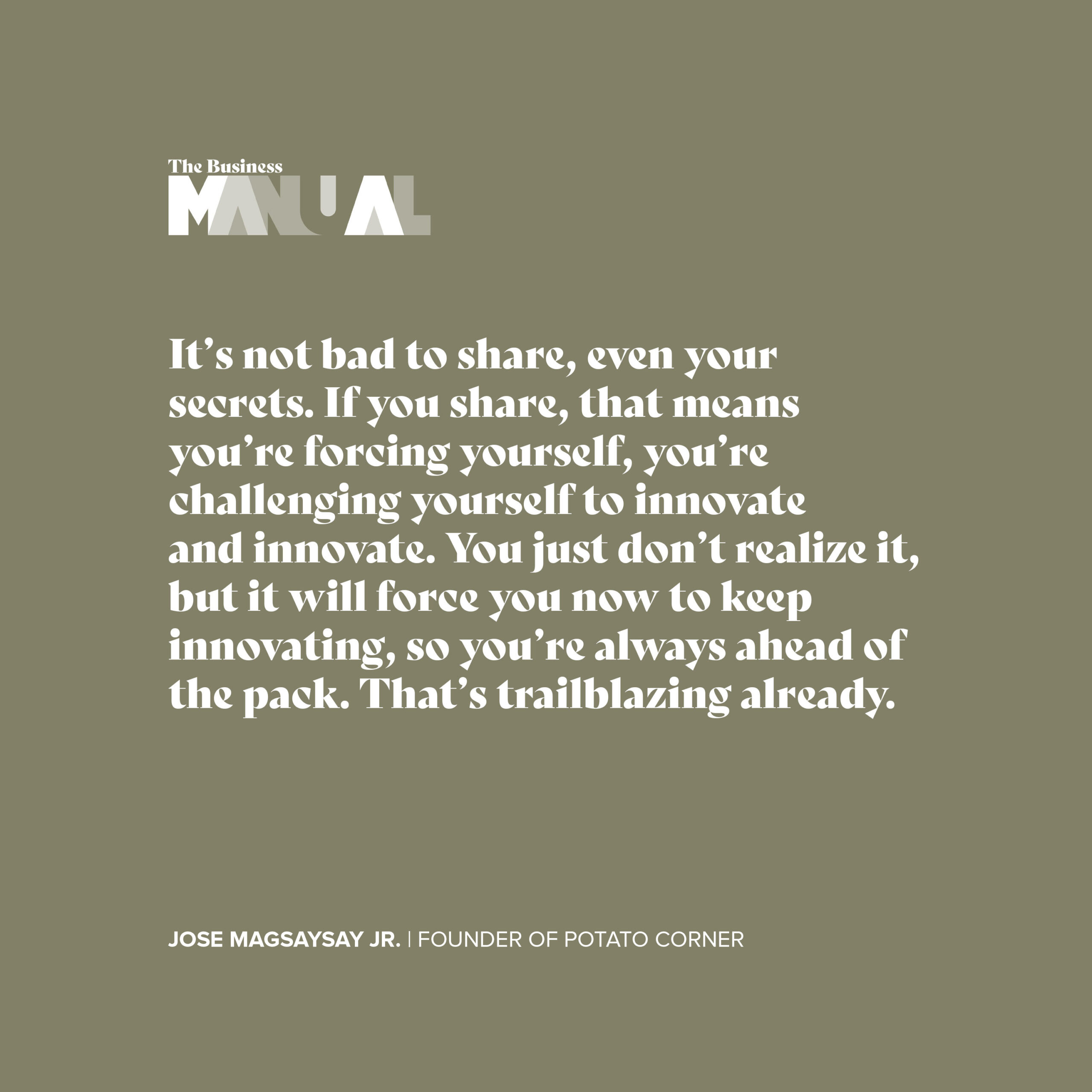
“It’s not bad to share, even your secrets,” he says candidly, amid growing fear that sharing secrets may incite more competition and copycats. “Even [at] Potato Corner, we keep telling our secrets. But we are always innovating enough so that every month or every six months.”
“It’s always changing. But if you share, that means you’re forcing yourself, you’re challenging yourself to innovate and innovate,” he ends. “You just don’t realize it, but it will force you now to keep innovating so you’re always ahead of the pack. So that’s trailblazing already.”
![Anybody can copy [a business]. But it's the way you do business that will set you apart, not the product. - Jose Magsaysay Jr](https://s3.ap-southeast-2.amazonaws.com/assets.thebusinessmanual-onemega.com/wp-content/uploads/2023/02/JOSE-MAGSAYSAY-QUOTE-6-scaled.jpg)
Text DIANE NICOLE GO
Photography EXCEL PANLAQUE of KLIQ INC
Sittings Editor RJ LEDESMA
Art Direction MARC YELLOW
Videography JR RAMIREZ of KLIQ INC
Video Producer MIGUEL LIM
Shoot Coordination PILAR ANGLIONGTO and TONI CALINGASAN
Shot on Location GYUD FOOD MARKET
More From Stories